Molotschna women’s exodus
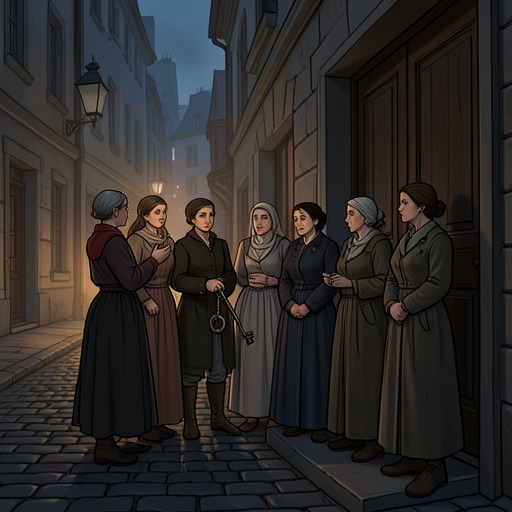
Women TalkingThe Molotschna women’s exodus is a collective departure shaped by a deadline, a threat of expulsion, and the women’s effort to act on their faith without submitting to violence. What begins as a choice among doing nothing, staying to fight, or leaving becomes a practical plan: the women will depart after dark, with children and supplies, before the colony’s men return.
Causes and Stakes
The immediate pressure is the expected return of imprisoned attackers. Most of the colony’s men have gone to the city to post bail, hoping the accused can come back to Molotschna while awaiting trial. Peters says that, when the perpetrators return, the women will be offered the chance to forgive them, a condition represented as necessary to secure everyone’s place in heaven. If they refuse, he says, they must leave for an outside world they know nothing about. The women have only two days to organize their response.
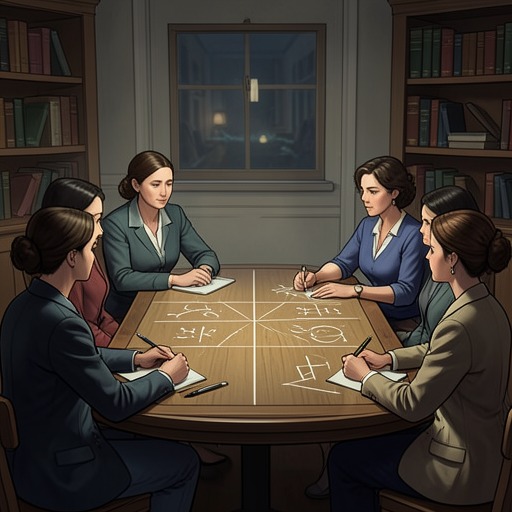
The threatened choice is therefore not simply whether to stay in familiar surroundings. Forgiveness is presented as an obligation with spiritual and communal consequences, while refusing it could mean exile. The women consider three courses: doing nothing, staying and fighting, or leaving. Ona Friesen helps set out the first heading for the argument in favor of staying and fighting, but when the discussion turns to leaving, Salome Friesen insists that there are no disadvantages to it. That assertion gives the departure a force beyond retreat: within the terms of the women’s deliberation, leaving is not a choice burdened by an acknowledged counterargument.
Faith and the Decision to Leave
Agata Friesen argues that remaining would place the women in direct proximity to further violence and could turn Molotschna into a battlefield. In her reasoning, choosing to stay would risk making violence, whether committed by the women or directed against them, part of their lives. That would betray the Mennonite commitment to pacifism and could compromise their ability to offer forgiveness freely. A forgiveness given under pressure, she argues, would not be genuine.
Her case for departure is affirmative as well as protective. By leaving, the women can pursue pacifism, love, and forgiveness without accepting a coerced reconciliation, and they can teach those values to their children. Agata presents the decision as a responsibility shared by mothers: the women have collectively judged what is best for their children and will act on that judgment. She connects maternal instinct not with thoughtless impulse but with intellect and faith, which she says have been neglected for too long. As the meeting moves from argument toward action, she frames the journey as a change the women have come to understand as consistent with God’s will and their responsibilities as mothers and human beings.
The women’s dispute with male authority also concerns access to religious interpretation. Salome Friesen argues that the women cannot know precisely what the Bible says because they have been unable to read it. Their supposed duty to submit to their husbands rests, as she understands it, on what their husbands have told them the Bible requires. The decision to leave thus challenges not only the men’s control over the women’s choices but also their exclusive power to explain the religious rules used to justify that control.
Organizing the Departure
After a day devoted to discussion, Agata proposes that the women act before the men return the following day. The agreed timing is after dark, so the convoy can pass the Chortiza and Hiakjeke colonies without being seen. The plan depends on more than resolve: transport, supplies, a route, and protection against disclosure all have to be coordinated while time is short.
August Epp reports that he has obtained the Co-op Safe, a stick of Dynamite, and a World Map. He wraps the map around a large block of cheese and covers it with ordinary brown paper. The Co-op Safe is placed beneath the back seat of Greta Loewen’s buggy. August also packs onions, soap, and pieces of wood, the last to provide traction if wheels become stuck in mud or to serve as kindling. These details make the departure a material undertaking, not merely a declaration: the group needs food, basic necessities, transport, and practical means of dealing with a difficult road.
The plan is threatened when Agata identifies the Koop brothers as potential informants or active obstacles. She says they are waiting for the women to move so they can ride to the city and notify the men, or perhaps prevent the departure themselves. Their claim that there is a fire north of Molotschna may be intended to push the women south, toward the city and the returning men. The route is therefore also a question of avoiding a trap, not just choosing a direction.
Preventing Disclosure
Salome Friesen’s response removes the Koop brothers as an immediate source of warning. She later tells August that she used Belladonna Veterinary Spray to make them unconscious. She had instructed Autje Loewen and Neitje Friesen to draw the brothers to the loft under a pretense of intimacy and create enough noise for her to enter without being noticed. According to Salome, they would no longer be able to go to the city and inform on the women. The account establishes the practical effect of the intervention: a likely channel of warning is closed before the convoy sets out.
At another point in the preparations, Agata directs Melvin to return to the children and wait with them in the fallow field beside the school. This instruction places the children within the plan’s coordinated movement rather than leaving them outside the women’s deliberations. The departure is organized around the group’s responsibility for them, even as the women must manage the risks posed by the men who may try to stop or report them.
The Convoy Moves
August watches Salome run away from the barn and catches sight of the buggies assembling behind the schoolhouse. Just before they move, a horse rears and shifts a buggy’s axle at a right angle, temporarily making forward movement impossible. The horse has to be calmed and the axle realigned. The delay is a small but concrete reminder that a collective decision does not make departure effortless: the plan remains dependent on animals, vehicles, and people responding to practical problems at the last moment.
Once the obstruction is corrected, the teams and buggies fall into formation. At least twelve vehicles, perhaps more, carry women, children, and supplies. From about two hundred metres away, August cannot distinguish individual faces or figures. The scene registers the exodus as a collective movement rather than a sequence of individual departures: the people who have argued over what faith and safety require are now gathered in a convoy, leaving after dark to avoid being seen.
The narrative records the departure beginning, not the group’s eventual arrival or the conditions of its life beyond Molotschna. Its decisive change is from deliberation to movement. The women’s plan remains rooted in the colony’s religious language, but they claim the authority to interpret that faith for themselves and to make a shared choice for their children. Their departure is at once a response to danger and an assertion that leaving, rather than accepting a coerced choice between submission and violence, can be an act of conviction.